Sourcing bulk bags is never a simple commodity purchase. A failed container heavily compromises worker safety, causes costly product loss, and halts active production lines instantly. You expect these industrial fabrics to perform flawlessly under immense dynamic stress. However, the current market remains saturated with inexperienced brokers and low-cost producers claiming high quality. This overwhelming noise makes it extremely difficult to distinguish a true strategic partner from a risky vendor. Choosing the wrong packaging provider routinely results in operational disasters and significant financial liabilities. You need a pragmatic, evidence-based framework to evaluate and shortlist a reliable FIBC Bulk Bag Supplier. This guide breaks down exactly how to assess technical capability, verify strict regulatory compliance, and ensure supply chain resilience. We will equip you with the knowledge to identify critical red flags and secure a packaging partnership built on verified trust.
Key Takeaways
Always demand unredacted, verifiable third-party testing certificates for Safe Working Load (SWL) and Safety Factor (SF).
A credible FIBC manufacturer must align their cleanroom and production certifications (e.g., BRCGS, ISO 22000) with your specific industry requirements (food-grade, pharmaceutical, or chemical).
Evaluate technical expertise by a supplier's ability to accurately match electrostatic classifications (Type A, B, C, D) to your material hazards.
Look beyond unit price; assess supply chain redundancy, local warehousing, and lead-time guarantees.
The Business Cost of Compromise in FIBC Sourcing
We must reframe how we view flexible intermediate bulk containers. They act as active components of workplace safety and product integrity. When you fill a bag with thousands of pounds of raw material, you rely entirely on its woven structural integrity. Compromising on material quality introduces severe operational risks. A dependable supplier understands this immense responsibility. They engineer products designed specifically for risk mitigation.
The Cascading Cost of Failure
A ruptured bag triggers a chain reaction of expensive consequences. First, sudden spillage requires immediate hazardous cleanup. Your facility operations stop abruptly. Forklift traffic ceases while teams isolate the affected area. Second, a broken container often contaminates the entire batch. You lose valuable raw materials instantly. Third, regulatory bodies monitor workplace accidents closely. OSHA and HSE issue severe compliance fines when unsafe material handling practices lead to structural failures. Finally, these delays disrupt your shipping schedules. Missed delivery windows damage your reputation irreparably.
Direct vs. Indirect Sourcing Costs
Prioritizing the absolute lowest unit price frequently creates massive long-term financial liabilities. Unverified producers often cut corners on UV stabilization or resin quality. These hidden defects manifest later during extended warehouse storage.
Direct Costs: The initial invoice amount paid for the empty containers.
Indirect Operational Costs: Lost product, idle labor during cleanup, disposal fees for ruined goods, and expedited freight charges for replacement packaging.
Risk Liabilities: Legal fees from workplace injuries, regulatory penalties, and lost customer contracts due to delayed shipments.
You cannot evaluate supplier proposals based purely on unit cost. The indirect costs of a single catastrophic failure always eclipse any minor upfront savings achieved through bargain hunting.
Verifying Quality, Compliance, and Testing Standards
Trust requires rigorous verification. A premier packaging partner actively proves their claims through exhaustive testing. They never ask you to rely blindly on their internal marketing materials.
In-House vs. Third-Party Testing
Robust in-house batch testing remains essential for daily quality control. Factories must perform continuous drop tests and tensile strength evaluations. However, a truly reliable supplier goes much further. They provide independent lab results from globally recognized institutions. You should actively look for unredacted reports from facilities like LABORDATA or the National Engineering Laboratory. Independent verification confirms the weaving facility calibrates their internal testing rigs correctly.
Best Practice: Document Review
Always cross-reference the batch numbers on the third-party certificate with the physical tags on your sample bags. Discrepancies here indicate a severe lack of traceability.
Load and Safety Metrics
You must require total transparency regarding Safe Working Load (SWL) and Safety Factor (SF) standards. The SWL defines the maximum weight the bag holds safely. The SF dictates the operational limits. Industry standards mandate a strict 5:1 safety ratio for single-trip containers. This means a bag rated for 1,000 kg must withstand 5,000 kg during laboratory destruction testing. Multi-trip usage requires a more robust 6:1 safety margin. Accepting anything less violates basic industrial safety protocols.
Industry-Specific Audits
Different materials demand entirely different manufacturing environments. You must verify supplier certifications based on your exact operational niche.
Industry Sector
Required Certifications
Critical Manufacturing Standards
Food & Beverage
BRCGS, SQF, ISO 22000
GFSI-recognized cleanrooms, 100% virgin polypropylene resin, rigorous pest control, metal detection protocols.
Rigorous drop testing, tear resistance verification, specific electrostatic dissipation parameters.
If you pack consumable goods, you require Global Food Safety Initiative (GFSI) recognized certifications. Food-grade FIBCS cannot originate from standard industrial weaving floors. Chemical handlers must secure UN-certified packaging approved for dangerous goods transport.
Assessing Technical Competence and Customization
A true partner acts as a proactive technical consultant. They never function as passive order-takers. They evaluate your entire material handling workflow before recommending a specific design.
Matching Containers to Materials
The supplier should aggressively audit your fill and discharge mechanics. They need to calculate your precise material bulk density. A fine powder flows differently than coarse gravel. If a vendor simply asks for dimensions and offers a quote, they lack technical depth. They must ask about your spout diameters, the clearance height of your filling rigs, and your warehouse stacking configuration.
Electrostatic Expertise
Handling fine powders generates immense static electricity. A qualified FIBC manufacturer demonstrates deep knowledge of anti-static parameters. They guide your decision process safely based on the Minimum Ignition Energy (MIE) of your specific material and the ambient warehouse environment.
Electrostatic Bag Classifications
Type A: Offers absolutely no electrostatic protection. Use these only for non-flammable products in environments completely free of combustible dust or vapor.
Type B: Features a low breakdown voltage. They prevent propagating brush discharges but do not dissipate static. Use them for dry, combustible materials in non-flammable environments.
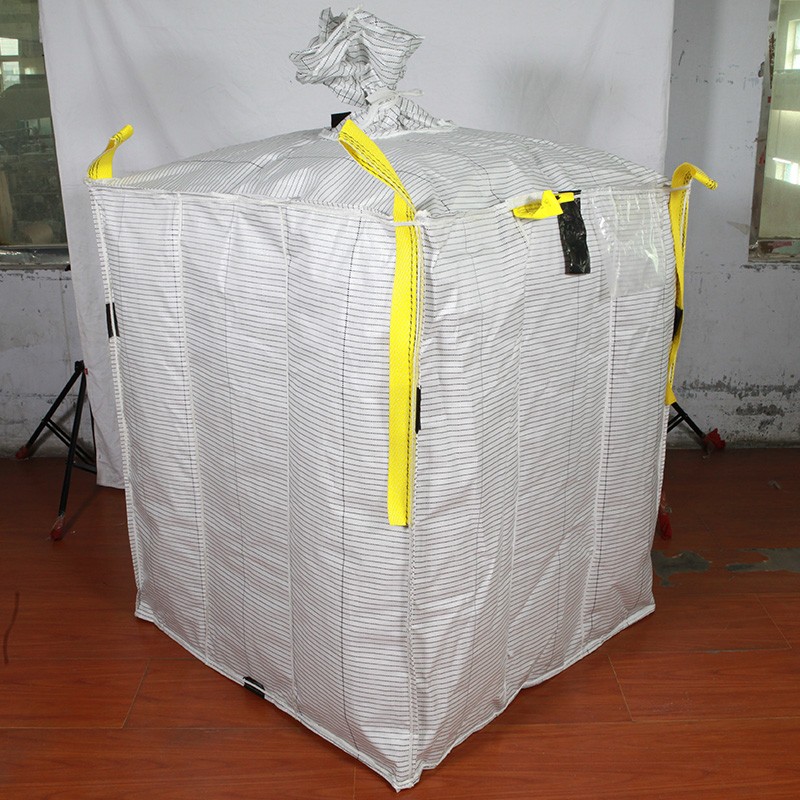
Type C (Grounded): Woven with interconnected conductive threads. You must physically ground these bags during filling and discharging. They safely handle flammable powders.
Type D (Dissipative): Made from specialized anti-static fabric. They safely dissipate static charges into the atmosphere without requiring a physical ground connection.
Design Customization Capabilities
Off-the-shelf designs rarely optimize operational efficiency. Evaluate the supplier's ability to customize top and bottom constructions. Duffle tops allow rapid filling, while specialized spouts offer controlled precision. Baffle bags feature internal fabric panels. These panels maintain a rigid square shape after filling, maximizing expensive shipping container space. Furthermore, sophisticated liners protect sensitive materials. Form-fit liners, foil barriers, and liquid-tight membranes prevent moisture ingress and oxidation.
Evaluating Supply Chain Resilience and Lead Times
Your production lines stop moving if empty packaging fails to arrive on time. You must thoroughly map a potential partner's supply chain infrastructure.
Manufacturing Capacity vs. Brokerage
You need to determine the exact nature of the vendor. Are they a direct manufacturer with captive factory capacity? Or are they a simple broker subject to severe spot-market volatility? A dedicated FIBC bag service provider offers stable, predictable output. Brokers often switch factories without notifying you, leading to dangerous inconsistencies in bag performance.
Geographic Diversification
Global logistics remain inherently unpredictable. Ask how the supplier handles geopolitical risks and sudden shipping delays. Relying on a single offshore weaving facility creates massive vulnerability. The best suppliers employ smart geographic diversification. They maintain dual-sourcing strategies across different regions. This redundancy protects you from localized raw material shortages and port strikes.
Vendor-Managed Inventory (VMI)
Just-in-time manufacturing requires flawless logistics. Ask about their Vendor-Managed Inventory programs. Do they offer local warehousing near your primary facilities? Safety stock programs ensure you never run out of critical packaging during unexpected demand spikes. Furthermore, you must verify their historical on-time-in-full (OTIF) delivery metrics. A promised lead time means nothing without verifiable data backing it up.
4 Red Flags When Vetting an FIBC Manufacturer
Procurement teams must remain vigilant during the evaluation phase. Certain behaviors clearly indicate a high-risk vendor. Walk away immediately if you encounter any of these four critical red flags.
Red Flag 1: Reluctance to Provide Physical Samples
A confident producer gladly supplies samples for rigorous field testing. You must perform trial runs on your actual equipment before signing a major purchase order. If a vendor hesitates, makes excuses, or charges exorbitant fees for a handful of test units, they likely know their product will fail under real-world stress.
Red Flag 2: Vague Quality Certificates
Scrutinize their documentation closely. Internally generated quality certificates lack credibility. If their reports do not trace back to specific production batches, the document holds no value. A legitimate certificate details the exact testing parameters, the date, the machinery used, and features signatures from certified laboratory technicians. Generic letters stating "we meet industry standards" signal a dangerous lack of compliance.
Red Flag 3: Unrealistic Lead Times
Weaving custom textiles takes time. Ocean freight schedules dictate rigid delivery windows. If a new supplier promises a delivery date drastically faster than established industry norms, they are likely ignoring global freight realities. This signals a classic bait-and-switch tactic. They will secure your deposit and subsequently blame "customs delays" for missing the impossible deadline.
Red Flag 4: Lack of Product Liability Insurance
Mistakes occasionally happen even in premier facilities. However, you must know how the vendor handles catastrophic batch failures. Ask for proof of robust product liability insurance. If they refuse to accept standard commercial terms regarding defective batches, they are transferring 100% of the operational risk directly onto your shoulders.
Shortlisting Logic: Next Steps for Procurement
You now understand the critical evaluation criteria. It is time to execute a structured, unyielding procurement process. Follow these four distinct steps to secure a reliable partner.
Step 1: The RFI Phase
Begin by demanding documentation first. Before discussing dimensions or quantities, request their compliance portfolio. Gather their updated ISO certificates. Request copies of their recent BRCGS or SQF audits. Ask for independent UN test reports. Discard any candidate who fails to produce these documents within forty-eight hours. Speed and transparency during the Request for Information (RFI) phase reflect their overall operational efficiency.
Step 2: The Pilot Run
Once you verify their credentials, initiate a limited pilot run. Order a small batch built specifically to your exact specifications. Do not use generic samples for this phase. Run these custom bags through your entire operational gauntlet. Fill them using your standard hoppers. Stack them in your warehouse at maximum height. Discharge the material to check for spout blockages or liner tearing. This step proves their translation of technical drawings into physical performance.
Step 3: Facility Audit
You should never trust a brochure. If geographical constraints permit, conduct a physical audit of the factory. Inspect the weaving looms, the cutting tables, and the sewing floors. If you require food-grade packaging, verify their cleanroom protocols firsthand. Check their air filtration systems and pest control traps. If an in-person visit is impossible, demand a live virtual video audit.
Step 4: Contract Formulation
The final step involves locking in your operational expectations legally. Draft comprehensive Service Level Agreements (SLAs). Define your lead time expectations clearly. Establish strict defect tolerance percentages. Outline the exact terms of your inventory holding and safety stock requirements. A professional supplier welcomes well-defined metrics because they already operate at that high level.
Conclusion
Selecting an FIBC bulk bag partner represents a vital exercise in corporate risk management. It requires far more diligence than standard procurement tasks. You must shift your internal focus away from pure transactional pricing. Instead, prioritize total operational value. Ensure absolute regulatory compliance, safeguard worker safety, and guarantee supply chain continuity.
A compromised bag halts your production and damages your bottom line. Take decisive action today. Schedule a technical consultation with your engineering team. Audit your current bulk bag specifications and compare them against modern safety standards. Demand independent testing certificates from your existing vendors. By applying this rigorous framework, you will secure a packaging partner fully capable of supporting your long-term industrial growth.
FAQ
Q: What is the difference between a direct FIBC manufacturer and a distributor?
A: A direct manufacturer owns the weaving facilities. They control production capacity, enforce strict quality traceability from raw resin to the final stitch, and implement robust factory standards. Distributors and brokers source bags from various third-party factories. This often dilutes quality control and creates severe traceability issues if a batch fails during your production process.
Q: How do I verify if an FIBC is truly food grade?
A: You must demand GFSI-recognized certifications, such as BRCGS, SQF, or ISO 22000. The supplier must produce the bags inside certified cleanrooms with positive air pressure. Furthermore, you must verify they utilize 100% virgin polypropylene resin. Using recycled materials introduces severe contamination risks and violates food safety regulations.
Q: Why is the Safety Factor (SF) important when choosing an FIBC bag service?
A: The Safety Factor defines operational legality and physical limits. A 5:1 ratio legally restricts the container to a single use; it breaks at five times its rated load. A 6:1 ratio indicates a stronger weave, allowing safe, multi-trip usage under controlled conditions. Ignoring these limits invites catastrophic workplace accidents.
Q: Can an FIBC supplier help prevent static electricity hazards?
A: Yes. A technically competent supplier acts as a safety consultant. They analyze the Minimum Ignition Energy (MIE) of your specific product. Based on your environment, they will specify Type C (grounded) or Type D (dissipative) bags. This directly prevents lethal explosive hazards when handling fine, combustible powders.