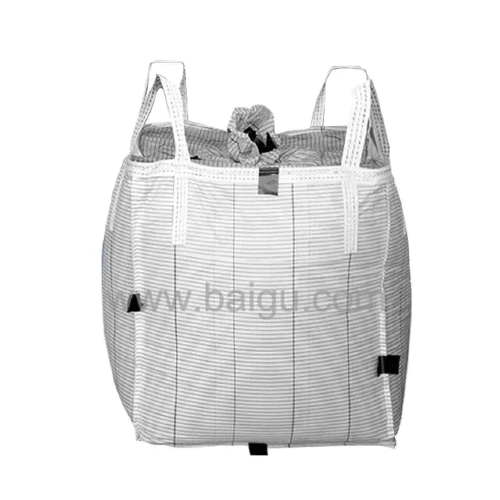
In volatile industrial zones, can a simple bulk bag prevent a massive explosion? Standard bags build dangerous static during filling, yet the Type C FIBC offers a "groundable" safety solution. This guide explains how these bags dissipate electricity to protect your facility from catastrophic sparks.
Key Takeaways
●Definitive Grounding: AType C FIBC utilizes a network of interconnected conductive threads to provide a safe, low-resistance path to earth.
●Explosion Prevention: By maintaining resistance below 107 ohms, these bags prevent dangerous brush discharges in flammable environments.
●Manual Safety Dependency: Unlike other options, a Type C FIBC requires active grounding via specific tabs to be effective.
●Material Integrity: The use of high-tenacity polypropylene with silver or carbon grids ensures durability and electrical continuity.
●Compliance Standards: Adhering to international IEC 61340-4-4 standards is mandatory for legal and operational safety.
●Critical Liner Choice: Only specialized conductive liners should be used to avoid creating an insulating barrier that traps static.
Understanding the Grounding Mechanism: How Type C FIBCs Work
The primary function of a Type C FIBC revolves around its ability to move static charges away from the material and the bag surface to a safe earth ground. Unlike standard bags, these containers act as a conductive circuit.
The Science of Interconnected Conductive Threads
Every Type C FIBC features a complex network of conductive silver, carbon, or steel threads woven directly into the polypropylene fabric. These threads are not just random inserts; they form a continuous grid across the entire structure. When static electricity builds up during the movement of powders or granules, these threads capture the electrons and provide a low-resistance path for them to travel.
Identifying the Primary Grounding Point (Tabs)
For the bag to function, it must connect to a grounding system. Manufacturers sew specific "grounding tabs" onto the bag—usually located near the lift loops or the discharge spout. These tabs are the focal points where the internal grid converges. Operators must attach a grounding clamp to these specific points to complete the circuit.
The Role of Electrostatic Dissipation in Preventing Brush Discharges
Without a path to ground, static builds until it reaches a "breakdown voltage," resulting in an incendiary brush discharge. In a Type C FIBC, the conductive grid ensures that the potential difference across the bag surface remains near zero. By neutralizing the charge as it generates, the bag eliminates the possibility of sparks that could ignite surrounding flammable vapors.
Safety is measured in resistance. International standards dictate that the resistance from any point on the Type C FIBC to the grounding point must be less than 107ohms. This specific threshold ensures that electricity flows fast enough to prevent accumulation but controlled enough to manage the discharge safely.
Active vs. Passive Protection: Why Grounding is a Manual Necessity
It is important to distinguish that Type C FIBCs provide "active-dependent" protection. While a Type D bag works passively, a Type C bag does nothing if it isn't physically grounded. This manual step is the bag’s greatest strength and its primary vulnerability, as it relies on human diligence or automated interlocks.
Monitoring Systems: Using Grounding Clamps with Interlock Controls
Many modern facilities use smart grounding systems. These clamps don't just hold the tab; they measure the resistance in real-time. If the connection fails or the resistance exceeds107ohms, the system triggers an interlock that immediately shuts down the filling or emptying machinery.
Ensuring Continuity Across the Entire Bag Surface
Total safety requires "point-to-point" continuity. This means the body of the bag, the loops, and the spouts must all be electrically linked. If a spout is made of non-conductive material, it becomes an isolated "island" of charge, which could still spark even if the rest of the bag is grounded.
Anatomy of a Type C FIBC: Materials and Construction
The durability and safety of a Type C FIBC depend on high-quality construction materials that balance physical strength with electrical conductivity.
High-Tenacity Polypropylene with Conductive Elements
The base material is typically virgin polypropylene, known for its high tensile strength. During the weaving process, manufacturers integrate conductive yarns. These yarns must be durable enough to withstand the mechanical stress of holding thousands of pounds of material without breaking the electrical circuit.
Grid Patterns vs. Stripe Patterns in Conductive Weaves
Most Type C FIBCs utilize a grid pattern. While stripe patterns provide vertical conductivity, a grid ensures that even if one thread is damaged, the charge can find an alternative path to the grounding tab. This redundancy is a critical safety feature in rugged industrial environments.
The Importance of Conductive Coating and Liners
In many cases, these bags require a coating to prevent moisture or sifting. This coating must also be conductive or thin enough not to block the discharge of static. If a liner is used, it must be a specialized Type C conductive liner that is physically bonded to the bag's grounding system.
Quality Control: Testing for Electrical Continuity During Manufacturing
Reputable manufacturers perform "breakdown voltage" and "resistance-to-ground" tests on every batch. They use megohmmeters to verify that the resistance stays within the safe range across multiple points of the bag surface.
Component
Material Type
Purpose
Base Fabric
Woven Polypropylene
Structural integrity and load bearing
Conductive Yarn
Silver, Carbon, or Stainless Steel
Creates the path for electron flow
Grounding Tabs
Reinforced Conductive Fabric
Connection point for grounding clamps
Coating
Conductive Polyethylene
Prevents leakage and moisture ingress
Key Applications: When to Use Type C FIBC for Flammable Materials
Choosing a Type C FIBC is often a matter of regulatory necessity based on the environment and the materials handled.
Handling Powders in the Presence of Flammable Solvents and Vapors
In chemical processing, powders are often discharged into vessels containing flammable solvents. The friction of the powder flowing creates static, while the solvent creates an explosive atmosphere. A Type C FIBC is the only safe way to bridge these two risks.
Safe Transport in Zone 1 and Zone 2 (Gas/Vapor) Environments
Atmospheres are classified by their explosion risk. In Zone 1 areas, where explosive gases are likely to occur in normal operation, Type C FIBCs are mandatory. They prevent the bag itself from becoming an ignition source in these volatile airspaces.
Protecting Against Low Minimum Ignition Energy (MIE) Dusts
Some materials, like sugar, flour, or certain pigments, have a very low Minimum Ignition Energy (MIE). Even a tiny, invisible static discharge can ignite a dust cloud. Type C FIBCs are designed specifically to keep the energy levels well below these MIE thresholds.
Cross-Industry Use Cases: Chemicals, Pharmaceuticals, and Fine Powders
●Chemicals: Resins, catalysts, and specialty polymers.
●Pharmaceuticals: Active Pharmaceutical Ingredients (APIs) often handled in solvent-rich environments.
●Fine Powders: Pigments, carbon black, and metallic powders.
Critical Safety Protocols for Operating Type C FIBCs
The safety of a Type C FIBC is only as good as the protocol used to handle it.
Mandatory Pre-Fill Inspection: Checking for Damaged Conductive Threads
Before use, operators should visually inspect the bag for rips or tears. More importantly, they should look for signs of corrosion or breakage in the conductive threads. If the grid is "broken," the bag cannot be grounded effectively.
The "No Ground, No Flow" Rule: Standard Operating Procedures
Companies should adopt a strict "No Ground, No Flow" policy. This means the discharge or fill spout remains closed until the grounding clamp is verified. This procedure prevents the initial surge of static that occurs when material first begins to move.
Environmental Factors: The Impact of Humidity on Static Generation
While Type C FIBCs are designed to handle static, very dry environments (low humidity) increase the rate of static generation. In these conditions, the grounding system works harder. Conversely, extremely high humidity can sometimes affect the surface resistance of certain conductive coatings.
Avoiding Common Mistakes: Using Non-Conductive Liners in Type C Bags
One of the most dangerous errors is inserting a standard polyethylene liner into a Type C FIBC. The standard liner acts as an insulator, trapping static inside the bag and preventing it from reaching the conductive grid. Always use liners specifically designed and tested for Type C containers.
Type C vs. Type D FIBC: Choosing the Right Protection
Understanding the difference between these two "anti-static" bags is essential for safety and budget planning.
Groundable (Type C) vs. Quasi-Static (Type D) Mechanisms
While Type C bags rely on grounding, Type D bags (such as Crohmiq) dissipate energy into the atmosphere via "corona discharge." Type D bags do not require a ground wire, which simplifies operations but requires the surrounding environment to be free of ungrounded conductors.
Operational Complexity vs. Human Error Risks
The weakness of the Type C FIBC is the human element. If an operator forgets to attach the clamp, the bag is unsafe. Type D bags remove this risk but are generally more expensive and have specific limitations regarding surface contamination (like grease or paint) that can inhibit their passive dissipation.
Cost-Benefit Analysis for Large Scale Industrial Operations
Type C bags are often more cost-effective for high-volume users who already have grounded infrastructure in place. Type D bags are favored in facilities where grounding is difficult to enforce or where turnover is high, and training on grounding protocols is a challenge.
When "Grounding-Required" Bags are Superior to Anti-Static Alternatives
In environments with highly flammable gases (low MIE), Type C is often preferred because the grounding provides a definitive, measurable path to earth. Safety officers often prefer the "certainty" of a measured ohm reading provided by Type C monitoring systems.
Compliance and International Safety Standards
Using a Type C FIBC is not just about safety—it is about legal compliance.
Deciphering IEC 61340-4-4: The Standard for Electrostatic FIBC Safety
This is the "gold standard" for FIBC safety. It defines the requirements for Type A, B, C, and D bags. For Type C, it mandates the resistance limits and testing methods. Ensure your supplier provides certification that their bags meet the latest version of this standard.
NFPA 77: Recommended Practice on Static Electricity
In the United States, the National Fire Protection Association (NFPA) provides guidelines on managing static. NFPA 77 outlines how to ground containers and the importance of maintaining a continuous path to earth in chemical processing plants.
Labeling Requirements: How to Identify a Certified Type C FIBC
Every certified bag must have a visible yellow and black safety label. This label should clearly state that it is a Type C FIBC, list the grounding requirements, and include the manufacturer’s data for traceability.
Documentation and Traceability for Safety Audits
In the event of an inspection or an incident, you must prove the bag was compliant. Maintain a file of "Certificate of Compliance" (CoC) documents for every shipment of Type C FIBCs you receive.
Longevity and Maintenance of Conductive Bulk Bags
Unlike standard bags, the safety features of a Type C FIBC can degrade over time.
Impact of Wear and Tear on Electrical Resistance
Repeated folding, heavy loads, and abrasion can snap the microscopic conductive fibers. Once enough fibers break, the resistance of the bag increases, eventually crossing the 107ohm limit and making the bag unsafe for flammable environments.
Cleaning Procedures Without Compromising Conductive Fibers
If you reuse Type C FIBCs, they must be cleaned carefully. Harsh chemicals or high-heat drying can damage the conductive elements or the coating. Always follow the manufacturer’s guidelines for "wet" or "dry" cleaning.
Recertification: When to Retire a Used Type C FIBC
Most safety-conscious companies limit the number of times a Type C FIBC can be reused. Before each reuse, the bag should ideally undergo a resistance test to ensure it still meets IEC standards. If it fails, it must be marked "UNSAFE" and disposed of.
Storage Best Practices to Prevent Fiber Degradation
Store these bags in a cool, dry place away from direct UV light. Ultraviolet radiation can degrade the polypropylene and the conductive yarns, leading to "dusting" and a loss of electrical continuity.
Conclusion
The Type C FIBC is an essential tool for safely handling materials in explosive environments. By using an interconnected conductive grid, it effectively eliminates electrostatic ignition risks. Baigu provides high-quality conductive bags that offer a measurable, secure path to earth for chemical operations. Protecting your facility starts with choosing the right bag and ensuring it remains properly grounded during every use.
FAQS
Q: What is a Type C FIBC?
A: A Type C FIBC is a groundable bulk bag with conductive threads designed to safely dissipate static electricity.
Q: How do you ground a Type C FIBC?
A: You ground a Type C FIBC by attaching a grounding clamp to the designated conductive tabs during filling.
Q: Why use a Type C FIBC for flammable materials?
A: A Type C FIBC prevents incendiary sparks that could ignite explosive vapors or combustible dust in hazardous zones.
Q: Is Type C safer than Type D?
A: While both prevent sparks, a Type C FIBC offers a measurable, low-resistance path preferred for high-risk environments.