Increasing global regulatory scrutiny and tightening enforcement around the transport of hazardous materials in 2026 demand a proactive approach to supply chain logistics. Updated international transport codes are forcing organizations to re-evaluate their containment strategies. The severe operational consequences of packaging failures range from catastrophic environmental spills and workplace chemical exposure to regulatory fines, port rejections, and voided commercial insurance policies. Navigating these risks requires more than basic procurement; it demands a strategic framework for evaluating, selecting, and implementing compliant containment solutions.
Procuring compliant packaging is a critical risk management function. Utilizing UN certified bulk bags ensures unbroken supply chain compliance while safeguarding personnel and the environment. This guide provides a comprehensive framework for understanding testing standards, mitigating operational risks, and selecting the right containment solutions for hazardous materials.
Regulatory Necessity: UN certification is a strict, legally mandated requirement for transporting hazardous materials, governed globally by international maritime, aviation, road, and rail regulations.
Rigorous Testing Standards: True UN bags must undergo and pass severe, standardized stress testing (including drop, topple, stacking, and vibration tests) that standard FIBCs are not engineered to survive.
Electrostatic and Chemical Safety: For many dangerous goods, physical strength is only half the battle; packaging must also mitigate electrostatic discharge hazards (Type C and Type D FIBCs) and chemical degradation.
Supplier Accountability: Partnering with a verified UN certified FIBC supplier requires proactive auditing of their third-party testing validity, manufacturing tolerances, and raw material traceability.
What Makes a Bulk Bag "UN Certified"?
The foundation of international hazardous material transport is the UN Recommendations on the Transport of Dangerous Goods, commonly known as the "Orange Book." This framework dictates domestic and international packaging laws across key regulatory bodies. In the United States, the Department of Transportation (DOT) enforces these rules through Title 49 of the Code of Federal Regulations (CFR). Internationally, the IMDG Code governs maritime transport, while IATA and ICAO regulate air freight. In Europe, the ADR and RID agreements control road and rail carriage. Compliance with these frameworks requires rigorous adherence to standardized testing protocols.
When a facility loads thousands of pounds of reactive chemicals into a flexible container, the margin for error is zero. Standard utility bags are built for agricultural goods or harmless construction debris. They lack the reinforced seams, specialized fabric weaves, and tested lifting loops required to contain dangerous goods under extreme stress. A UN bag is engineered specifically to survive catastrophic transit events without breaching.
Mandatory Technical Testing Protocols
To achieve certification, the packaging design must survive a battery of physical tests designed to simulate extreme transit conditions. Independent testing laboratories execute these protocols, and a failure in any single category results in a complete rejection of the design.
Top Lift Test: The bag must maintain a 6:1 safety factor during temporary suspension. Technicians load the bag to six times its maximum safe working load and suspend it. The lifting loops and fabric must not tear or permanently deform.
Drop Test: Filled bags are dropped from specified heights based on their Packing Group (up to 1.8 meters for certain classifications) onto a rigid, non-resilient surface. The pass criteria mandate absolutely no leakage of contents upon impact.
Topple Test: The bag is toppled from a specific height onto any part of its top. This verifies the integrity of the seams, the discharge spout closure, and the top duffle or flap mechanisms.
Righting Test: A toppled bag is lifted to an upright position using only two lifting loops (or one, depending on the design). This tests the fabric's resistance to localized stress and tear propagation when handled roughly by a forklift.
Tear Test: A 100mm knife cut is made at a 45-degree angle on the main body of the bag. The bag is then loaded to its maximum capacity and suspended. The cut must not propagate more than 25% of its original length under pressure.
Stacking Test: This simulates the load of stacked bags in a ship's hold or warehouse. A top load equivalent to the maximum weight of stacked bags is applied for 24 hours. The bag must maintain structural stability without leaking or collapsing.
Vibration Test: Mandated by DOT (49 CFR § 178.819), this test simulates transit fatigue over long distances. The bag is placed on a vibrating platform for one hour at a frequency that causes the bag to leave the platform surface slightly. It is a critical evaluation often overlooked by unaccredited manufacturers.
Decoding the UN Symbol and Marking Codes
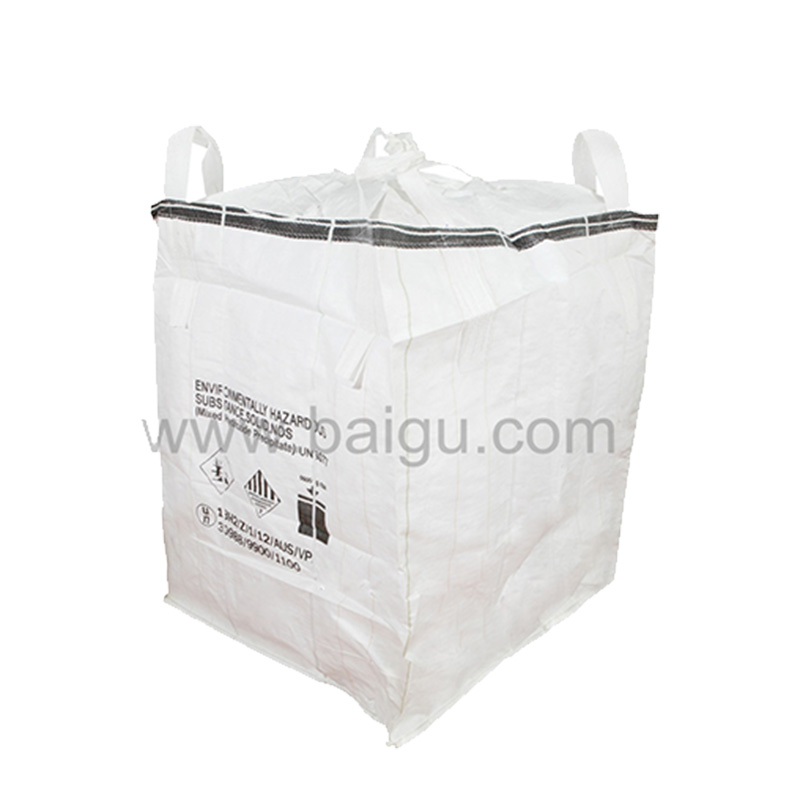
Every certified bag features a specific marking string printed visibly on its body or tag, such as UN 13H3/Y/03 26/USA/+MM1234/7400/1000. This code provides a complete history and specification profile for the packaging. It begins with the official UN Packaging Symbol. The Packaging Type Code follows, such as 13H1 for uncoated bags without liners or 13H4 for coated bags with liners. The Packing Group Code (X, Y, or Z) indicates the level of danger the bag is authorized to contain. The string also includes the month and year of manufacture, the country of certification, the manufacturer's code, the stacking test load in kilograms, and the maximum gross mass permitted.
The Financial and Operational Risks of Non-Compliance
Transporting hazardous materials in uncertified or counterfeit packaging invites severe legal and civil ramifications. Regulatory bodies impose strict penalty structures per violation, per day, for non-compliance. DOT inspectors and port authorities actively target hazardous shipments for documentation and packaging audits. A single missing UN mark or an improperly closed spout can trigger an immediate halt to the shipment.
Beyond fines, supply chain disruptions present a massive operational risk. Customs holds, impounded shipments, and transit delays compound the logistical challenges. When a port rejects a non-compliant container, the shipper must arrange for emergency product transfers into certified packaging on-site. This requires specialized hazmat teams, secondary containment vessels, and exorbitant emergency service fees, often dwarfing the original value of the cargo.
Workplace safety and environmental integrity are equally at risk. A packaging failure on a loading dock or inside a shipping container can result in chemical burns, respiratory hazards for site personnel, and extensive environmental contamination. The remediation costs for a hazardous material spill run into the hundreds of thousands of dollars, involving soil excavation, water testing, and long-term monitoring. Furthermore, commercial general liability and environmental pollution insurance policies often deny coverage if an investigation determines that uncertified packaging was used to transport dangerous goods. Sourcing reliable hazardous material packaging is a fundamental requirement for risk mitigation.
Classification of Hazardous Material Packaging
Understanding the compatibility between the chemical properties of the payload and the design of the bulk bag is necessary for safe transport. The UN classifies hazardous materials into three Packing Groups based on the degree of danger they present. Packing Group I represents high danger, Packing Group II represents medium danger, and Packing Group III represents low danger. Flexible Intermediate Bulk Containers (FIBCs) are generally restricted to Packing Groups II (Y-marking) and III (Z-marking). They are never permitted for Packing Group I materials, which require rigid containment like steel drums or specialized IBC totes.
Types of UN Bags (Design Classifications)
Certified FIBC designs fall into specific categories based on their construction and barrier properties. Selecting the correct type depends entirely on the physical state and chemical reactivity of the material being shipped.
13H1: Unwoven plastic, uncoated, without liner. Suitable for dry, non-dusty granular materials that do not react with moisture.
13H2: Woven plastic, coated, without liner. The coating provides sift resistance for fine powders but does not offer a true moisture barrier.
13H3: Woven plastic, uncoated, with liner. The internal liner provides a barrier against moisture and contamination, ideal for hygroscopic materials.
13H4: Woven plastic, coated, with liner. Offers the highest level of protection for flexible containers, combining sift resistance with a dedicated internal barrier.
The chemical properties of the material dictate the need for specific barrier layers. Hygroscopic materials, oxidation risks, and vapor emissions require aluminum foil, conductive, or high-barrier liners to prevent sifting and hazardous interactions. A standard polyethylene liner might suffice for basic moisture protection, but aggressive chemicals may require specialized co-extruded films to prevent degradation of the outer polypropylene shell.
The Intersection of UN Certification and Electrostatic Safety
Handling flammable or explosive powders introduces the severe risk of dust explosions. When filling or discharging dry powders, the friction generates significant static electricity. If this static discharges as a spark in a dust-heavy environment, the resulting explosion can level a facility. When required, a certified bag must also carry electrostatic protection certification.
Type B: Features a low breakdown voltage (less than 6kV) to prevent propagating brush discharges. It does not dissipate static and cannot be grounded.
Type C (Groundable): Contains internally interconnected conductive threads woven into the fabric. These bags must be physically grounded to the earth during filling and discharging to safely channel static electricity away from the hazard zone.
Type D (Dissipative): Utilizes static-dissipative fibers that safely disperse static charges into the atmosphere via corona discharge without the need for physical grounding. This eliminates the human error risk associated with forgetting to attach a grounding cable.
Comparison of UN FIBC Classifications and Applications
UN Code
Coating
Liner
Best Application
13H1
None
None
Dry, non-dusty granular materials (e.g., certain fertilizers)
13H2
Coated
None
Fine powders requiring sift resistance (e.g., titanium dioxide)
13H3
None
Included
Moisture-sensitive granular materials (e.g., specific salts)
13H4
Coated
Included
Highly sensitive, fine hazardous powders (e.g., reactive chemical intermediates)
How to Evaluate a UN Certified FIBC Supplier
Partnering with a reliable UN certified FIBC supplier requires rigorous due diligence. Buyers must independently verify a supplier's test reports through recognized, ISO/IEC 17025 accredited testing laboratories, such as TEN-E or IIP. Accepting self-certified documents introduces unacceptable risk. You must request the actual laboratory report and verify that the certificate has not expired, as UN certificates typically require renewal and re-testing every year or two depending on the jurisdiction.
Quality Management Systems (QMS) and manufacturing tolerances are critical. ISO 9001 certification and continuous in-house testing ensure that production bags match the tested prototype's exact specifications. The fabric weight, seam construction, thread count, UV inhibitor percentage, and tape width must be identical to the bag that passed the lab tests. Any deviation, even a minor change in the sewing thread material, invalidates the certificate and renders the packaging illegal for hazardous transport.
Uncompromising traceability and batch testing standards are mandatory. Suppliers must provide individual lot tracking, manufacturing dates, and the ability to trace a finished bag back to the specific raw polymer resin batch. If a failure occurs in the field, you must be able to isolate the affected batch immediately. A premier supplier also acts as a technical advisor, helping buyers match the correct UN code on their safety data sheets (SDS) to the appropriate bag specification, ensuring the packaging aligns perfectly with the chemical hazards.
Procurement Trade-Offs and Value Influencing Factors
Evaluating dangerous goods packaging involves understanding the strict regulatory boundaries of customization. Modifying a certified bag—whether altering dimensions, fabric weight, lifting loop design, or discharge configuration—invalidates the original certificate and requires a complete design re-test. This means you cannot simply ask a manufacturer to add a few inches to the height of a UN bag to fit more product without triggering a new round of laboratory testing, which takes time and resources.
Rigorous compliance testing, strict manufacturing tolerances, and certification approvals impact production lead times. Organizations must implement proactive inventory forecasting and safety stock programs to prevent supply chain bottlenecks. You cannot source these bags on short notice from unverified spot markets. The value of certified packaging lies in its ability to protect the organization from catastrophic liability and operational downtime. Planning procurement cycles months in advance ensures a steady supply of compliant packaging, avoiding the need to halt production lines due to a lack of authorized containers.
Implementation Risks and Mitigation Strategies
Mechanical stress during high-speed filling can tear bags and compromise their integrity. Ensure filling spouts, lifting hooks, and automatic discharge mechanisms are compatible with the bag's design to prevent punctures. Forklift tines must be smooth and rounded; sharp edges will easily slice through the polypropylene fabric under load. Operators must be trained to lift the bags vertically, avoiding angled pulls that place undue stress on individual lifting loops.
Environmental degradation is another significant risk. Polypropylene packaging is highly susceptible to UV degradation. Even with UV inhibitors added during the extrusion process, prolonged exposure to direct sunlight will break down the polymer chains, drastically reducing the bag's tensile strength. Warehousing protocols must mandate dry, temperature-controlled environments away from direct sunlight and ozone-producing machinery (like electric forklifts or welding stations) to maximize shelf life. A bag stored outside for a month may fail a drop test that it would have easily passed when new.
Finally, the "zero-tolerance" closure protocol must be strictly enforced. A bag is only legally compliant if closed exactly according to the manufacturer's certified instructions. Failing to execute the exact tie-off, folding, or sealing method invalidates the UN rating during transit inspections, leading to immediate compliance failures. If the test report specifies a "swan neck" fold secured with a specific zip tie, using a standard knot or a different type of tape renders the packaging non-compliant. Facility managers must post these closure instructions directly at the filling stations and audit operators regularly.
Conclusion
When transporting dangerous goods, utilizing compliant UN certified bulk bags is a non-negotiable regulatory mandate and a foundational pillar of corporate risk management. To ensure compliance and operational safety, implement the following steps:
Audit your current packaging specifications against the latest IMDG, DOT, and ADR regulations to identify compliance gaps.
Request and independently verify third-party ISO/IEC 17025 laboratory test reports from your supplier before issuing purchase orders.
Implement strict warehouse protocols to protect inventory from UV degradation, moisture, and environmental damage.
Train all site personnel on the exact, manufacturer-specified closure protocols to maintain certification validity during transit.
Establish a traceability program that links specific bag lot numbers to outbound hazardous material shipments for rapid recall capabilities.
FAQ
Q: Can I use a standard FIBC for hazardous materials if it is strong enough?
A: No. Standard FIBCs do not undergo the specific, legally mandated drop, topple, and vibration tests required for hazardous materials. Only certified bags with the proper UN markings are legally permitted for dangerous goods transport.
Q: What does the 'Y' mean in a UN marking code?
A: The 'Y' indicates the bag is approved for Packing Group II (medium danger) and Packing Group III (low danger) materials. It cannot be used for Packing Group I (high danger) materials.
Q: How long is a UN certificate valid for a specific bag design?
A: Certificates are generally valid for a specific period, often requiring periodic re-testing annually or bi-annually depending on the regulatory body and the testing laboratory's protocols.
Q: Can I change the lifting loops on a certified bag without re-testing?
A: No. Any structural modification, including changes to lifting loops, fabric weight, or dimensions, invalidates the existing certificate and requires a completely new round of third-party testing.
Q: Are Type C bags automatically UN certified?
A: No. Type C refers to electrostatic discharge protection. A bag must undergo separate physical stress testing to achieve UN certification for hazardous materials.
Q: What happens if a bag is not closed according to the manufacturer's instructions?
A: If the closure method deviates from the certified instructions, the bag is legally considered non-compliant. This can result in failed inspections, fines, and port rejections.